
PHP Warning: Module “zip” is already loaded in Unknown on line 0
In most vapor recovery trains, condensation is the first stage and membrane separation follows it. That order is not arbitrary. Condensation removes the bulk of the recoverable hydrocarbon by cooling the stream below its dew point, and the membrane stage then concentrates what remains. Reversing the order would put a large hydrocarbon load through the membrane with no preceding bulk removal, which increases membrane area, raises the recycle load and makes the whole train harder to control.
What condensation does well
Condensation handles the majority of the load with a simple mechanism and no moving parts in the separation path. Its limit is that the exit stream remains saturated at the condenser temperature, so a residual hydrocarbon concentration always passes through. Lowering the temperature further reduces that residual but increases refrigeration duty and frost risk, and the gains become progressively smaller.
What the membrane stage adds
A membrane stage works on partial pressure rather than temperature. Hydrocarbon molecules pass through the membrane preferentially because they are more soluble and more mobile in the membrane material than the light gases around them. The result is a permeate stream enriched in hydrocarbon that is recycled back to the front of the train, and a retentate stream depleted in hydrocarbon that leaves the system.
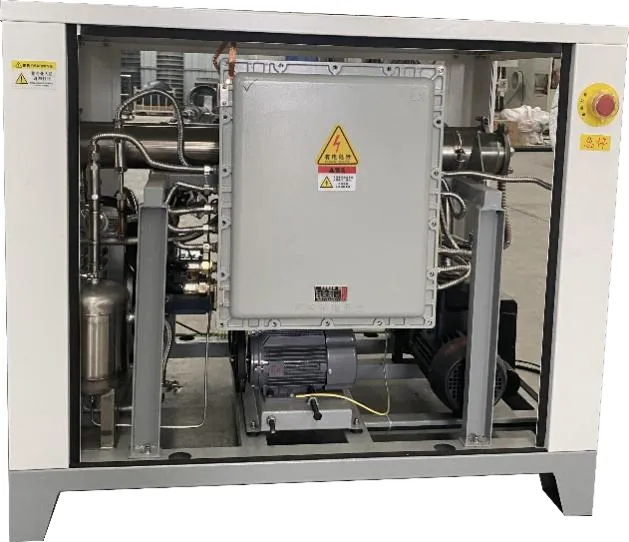
The membrane therefore does not replace condensation. It extends the recovery range into the region where further cooling would cost more than it recovers. The two stages are sized together: the condenser sets the inlet condition to the membrane, and the membrane sets how much hydrocarbon returns to the condenser.
How the two stages interact
| Interaction | What happens | Why it matters |
|---|---|---|
| Condenser outlet temperature | Sets the feed condition to the membrane | Warmer feed raises membrane load |
| Recycle stream | Returns hydrocarbon to the train inlet | Recycle load affects condenser duty |
| Inlet hydrocarbon concentration | Drives membrane driving force | Higher concentration favours the membrane |
| Pressure across the membrane | Provides the separation driving force | Vacuum or compression both change the balance |
| Moisture and heavy components | Can affect membrane performance | Pretreatment protects the membrane |
| Turndown | Changes flow and pressure ratios | Control strategy has to cover the turndown range |
Starting the train correctly
- Establish the vapor rate and composition the train has to handle;
- Set the condenser duty and outlet temperature for bulk hydrocarbon removal;
- Measure or estimate the residual hydrocarbon leaving the condenser;
- Size the membrane area for that residual and the required final concentration;
- Confirm the recycle stream can be absorbed by the condenser without upsetting it;
- Check that the control strategy holds the train stable across the expected turndown.
Frequently asked questions
Can the membrane stage run on its own?
It can be used alone for some duties, but where the inlet hydrocarbon concentration is high, removing the bulk by condensation first reduces the membrane area needed and keeps the recycle stream manageable.
Why is the recycle stream important?
It returns hydrocarbon to the front of the train, which increases the load on the condenser. If the recycle is not accounted for when sizing the condenser, the train can end up circulating more hydrocarbon than it removes.
Does the membrane need pretreatment?
Protecting the membrane from liquids, heavy components and excessive moisture extends its working life. What pretreatment is needed depends on the stream, and it is best decided from an analysis of the actual vapor rather than a general rule.
Luoyang Wohong Petrochemical Equipment Co., Ltd. designs and manufactures vapor recovery units, membrane separation skids and condensers for fuel depots, terminals and retail sites. Contact us for duty assessment and equipment selection support.