
A quiet shift is running through fuel retail: instead of new builds, the volume has moved to upgrading what already exists. Networks are sending engineering teams down their station lists, station by station, adding vapor recovery to forecourts that traded for years without it. The retrofit wave is reshaping equipment order books in 2026, and it is changing what suppliers are asked to deliver and how they are asked to deliver it.
Why retrofits took the lead
The arithmetic behind the wave is plain. Land for new stations is scarce and pricey in the growing urban corridors, while the existing estate sits exactly where the traffic already is. Regulation moved too: emission rules now reach stations that were built before them, and operators prefer choosing their upgrade window over having one assigned. Add financing that favors upgrades of proven sites, and the retrofit program becomes the main channel through which vapor equipment reaches the market.
What the retrofit buyer asks for
| Priority | Why it dominates | How suppliers respond |
|---|---|---|
| Compact footprint | Existing sites have no spare yard | Skids sized for corners, not green fields |
| Short install windows | The station must keep selling fuel | Preassembled packages with overnight changeovers |
| Retrofit surveys first | No drawings exist for old sites | Survey kits and remote sizing support |
| Phased pricing | Programs roll out over seasons | Framework prices held across station batches |
| Proof of performance | Each site reports into the program | Standard acceptance runs on every handover |
How a retrofit program actually rolls
The programs filling order books this year share a rhythm that keeps a hundred stations moving without chaos:
- Survey the first batch of sites and sort them by difficulty, not by geography;
- Standardize one or two equipment packages so every site gets the same answer;
- Install in short windows around trading hours, one crew per region;
- Hand over with the same acceptance run each time, so results compare across sites;
- Feed lessons from the first ten sites forward before the next hundred are ordered.
What this wave means for equipment demand
Retrofit demand differs from greenfield demand in texture, not just size. Units ordered for the retrofit estate are smaller on average, packaged tighter and bought in repeating batches that reward suppliers with stock and short lead times. Membrane skids and compact condensation units both ride the wave, and the suppliers winning batches are the ones treating a fifty-station program as a product line of its own, with its own surveys, kits and handover documents.
Reading the year ahead
The drivers behind the wave are not seasonal. Regulatory calendars publish years in advance, financing structures favor the existing estate, and every completed batch makes the next one easier to approve. Order books across the equipment trade reflect that durability, and the conversation has moved from whether the retrofit estate will be equipped to how quickly the installation base can grow to meet it.
Frequently asked questions
Do retrofit units perform like greenfield installations?
When the survey is honest and the package is sized for the actual duty, yes. The physics does not care how old the station is; it cares about vapor tightness, line condition and duty match. Programs that invest in the survey stage report acceptance results their greenfield colleagues would recognize.
Which equipment format wins the retrofit estate?
Both membrane and condensation formats win batches, and the split follows duty and site constraints rather than fashion. Compact membrane skids dominate where purity targets and footprint favor them, while robust condensation packages hold their ground where duty is heavy and maintenance crews prefer mechanical simplicity.
How should a small network join the wave?
By borrowing the program structure rather than the program scale: survey the estate, pick one package, order in one batch and use one acceptance standard. The economics that favor large networks favor any network that repeats, because repetition is where the retrofit savings actually live.
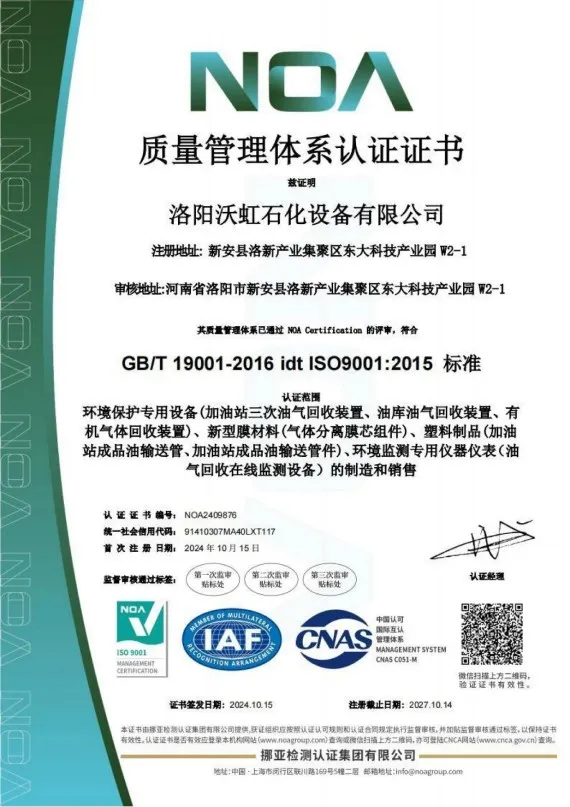
Luoyang Wohong Petrochemical Equipment Co., Ltd. designs and manufactures vapor recovery units, membrane separation skids and condensers for fuel depots, terminals and retail sites. Contact us for duty assessment and equipment selection support.