
A vapor recovery unit (VRU) captures the fuel vapour that would otherwise escape when petrol is loaded, unloaded or stored, and returns it to liquid form so it can go back into the tank. Most units work in a continuous loop: vapour is collected from the source, passed through one or more separation stages, and the recovered liquid is returned while the cleaned air is vented. This article explains that loop and the three separation technologies that do the actual work — condensation, absorption and membrane separation.
The Problem a VRU Solves
- Vapour is displaced whenever a tank is filled or emptied, and leaves the system through vents.
- Fuel vapour is both a product loss and an emission that regulators increasingly require to be controlled.
- Simply venting the vapour wastes fuel that has already been paid for.
Stage by Stage: The Vapour Loop
- Capture: vapour is collected at the source — a storage tank, a loading arm, or a dispenser — through a closed vapour line rather than an open vent.
- Transfer: a small blower or compressor moves the vapour to the treatment unit at a controlled rate.
- Separation: one or more stages remove the hydrocarbon from the vapour stream and turn it back into liquid.
- Liquid return: recovered fuel is routed back to the storage tank.
- Clean venting: the remaining air, now low in hydrocarbon, is vented to atmosphere.
- Control: pressure, temperature and hydrocarbon concentration are monitored so the unit responds to changes in load.
Three Core Separation Technologies
| Technology | How it works | Typical role |
|---|---|---|
| Condensation | The vapour stream is cooled so hydrocarbons change from gas to liquid | First stage; recovers the bulk of the vapour, especially at higher concentrations |
| Absorption | Vapour contacts a liquid absorbent that dissolves the hydrocarbon | Used where a suitable absorbent and regeneration route exist; common in some terminal applications |
| Membrane separation | A membrane preferentially passes hydrocarbon, concentrating it in a smaller stream | Polishing stage; concentrates the remaining vapour so it can be recondensed |
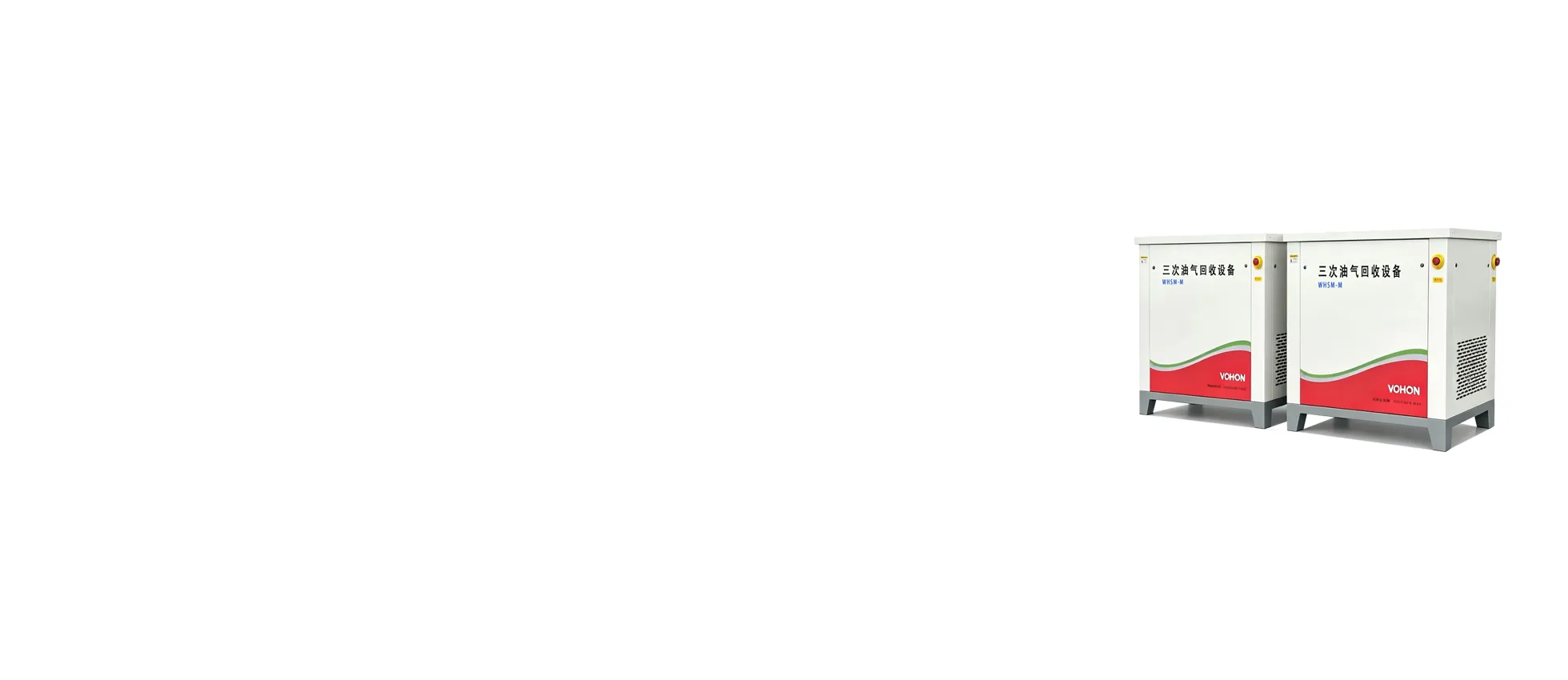
Why Stage III Systems Combine Technologies
Cooling alone recovers most of the vapour, but pushing condensation further to chase the last few percent becomes increasingly expensive per unit recovered. A membrane stage placed after condensation takes the dilute remaining stream and concentrates the hydrocarbon, which is then returned to the front of the unit for another pass. The result is a smaller, more economical unit for the same recovery performance than deep cooling on its own.
Sizing and Selection Factors
- Vapour volume and peak flow rate, which set the blower and separator size.
- Hydrocarbon concentration and its variation through the day.
- Fuel type and blend, which affect condensation behaviour.
- Required recovery performance and local emission limits.
- Ambient conditions, enclosure type and available utilities on site.
- Whether the unit handles storage tank vapour, loading vapour, or both.
Frequently Asked Questions
Q: Does every VRU use all three technologies?
A: No. Many units rely on condensation alone or condensation with a membrane stage. Absorption is used where the site has a suitable absorbent and regeneration arrangement.
Q: What happens to the recovered fuel?
A: It is returned to the storage tank as liquid, where it rejoins the product inventory.
Q: Can a VRU handle both loading and storage tank vapour?
A: Units are configured for the vapour sources on a given site; some serve loading only, some serve tanks, and some are designed for both.
Q: How is performance measured?
A: By the hydrocarbon concentration in the vent stream and the volume of liquid recovered, both monitored under the site’s operating conditions.
Luoyang Wohong Petrochemical Equipment Co., Ltd. designs and manufactures vapour recovery units based on condensation combined with membrane separation, serving petrol stations, depots and fuel transfer applications. Contact us to discuss your vapour sources and site conditions.